Anja Kamenarič
Doctoral Researcher I University of Ljubljana
Publishing Studies · Translation Flows · AI in Publishing

Recent Events

CLMCE Summer School: Communities, Fandoms and Materiality
Reading Spaces: Children’s Bookstores as Cultural and Emotional Environments
Lecture at Academy of Sciences and Literature, Mainz
04. 08. 2026, 10:00 – 11:00
This lecture explored children’s bookstores as cultural, educational, community, and emotional environments that shape children’s relationships with books and reading. Drawing on my professional and research experience with the bookstore of Ljubljana Puppet Theatre, the talk developed into a comparative examination of seven specialist children’s bookstores across Europe. Based on qualitative case studies and interviews conducted with bookstores in Slovenia, France, Serbia, Germany, Italy, Norway, and the Czech Republic, it investigated how different models of children’s bookselling understood and practised their cultural and mediating roles.
The lecture examined recurring themes including the missions of children’s bookstores, spatial design and atmosphere, book selection and recommendation, the role of the children’s bookseller, cultural and educational programming, relationships with local communities and institutions, and the balance between cultural work and economic sustainability. Particular attention was given to the human, sensory, and emotional qualities of physical bookstores and to their capacity to offer children personal encounters, unexpected discoveries, and positive memories of books and reading that digital platforms and algorithmic recommendation systems cannot easily reproduce.
Latest Publications
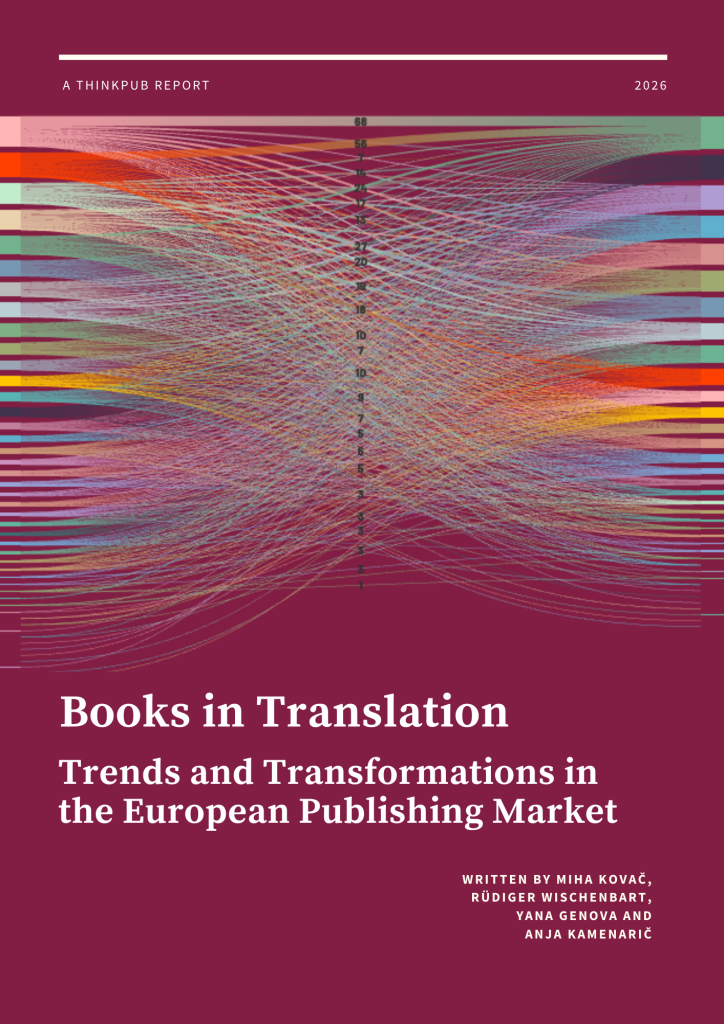
Books in Translation
Trends and Transformations in the European Publishing Market
Written by Miha Kovač, Rüdiger Wischenbart, Yana Genova and Anja Kamenarič
The report was developed within the international ThinkPub project and supported by the Creative Europe programme. It provides a comprehensive analysis of how translated books are produced, distributed, and marketed across European markets, with a focus on smaller linguistic regions and independent publishers. It highlights that in small markets, translations are essential—making up 20–40% of output—while larger markets rely more on domestic works, and that translation flows remain heavily dominated by English, reinforcing cultural imbalances despite emerging trends like the rise of Japanese literature. The report identifies a major shift in the role of translators toward active market agents and emphasizes the growing influence of digital platforms, self-publishing, and subscription services in reshaping the industry. It also finds that AI and machine translation tools, while expanding, currently favor dominant languages and pose challenges for smaller ones. Finally, the report evaluates public funding systems, noting uneven support and strategic gaps across countries, and positions translation as a critical infrastructure for cultural diversity, market sustainability, and access to knowledge in Europe.
Out now! Download here: Books in Translation
University Information
Faculty of Arts
University of Ljubljana
Research Profiles
Contact Information
+386 1 2411 310